Wednesday, July 8, 2009
overheard
"I'm the only Duck driver brave enough to say it: Punk Rock Girl."
-- driver of a Ride the Ducks bus/boat to tourists on board, pointing out the store that used to be Zipperhead, "immortalized" by The Dead Milkmen in their song "Punk Rock Girl."
All last summer, in one of the apartment windows on South Street, there was a sign that said FUCK THE DUCKS.
Monday, June 15, 2009
what i've wanted
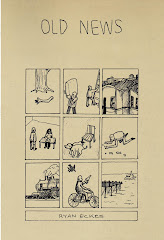
I started this blog last year to post pieces of a manuscript as it developed, but I wound up posting other things, too, adjacent concerns, whatever I wanted. So the blog is Old News but the blog is not the Old News that is the manuscript. I might post the complete, ordered mss. here soon. As I finish it up, some notes here on what I’ve wanted to do:
I first got interested in poetry, about ten years ago, because I saw in what I was reading the possibility of telling a story that was also a meditation. (I was inspired by two poetry classes I took my last year in college: Postmodern American Poetry, taught by Jeffrey Nealon, and a writing workshop taught by CS Giscombe, whose book Here was also a big influence.) Since then, I’ve tried to address, through writing, the question of how to inherit the world. And directly correlated: how to be in the world. How to live.
Old News is driven by doubt yet hinged on the idea that one must invent (rather than find) one’s own way of being/doing (faith), and that this must happen through interaction with one’s neighbors, with one’s nearest public, while remaining conscious of that public’s slippery extensions into more distant publics.
I wanted to write a book about my neighbors that was a little history book of Philadelphia, a narrative driven by conflicts I see and feel, hashed out by characters (neighbors) who recur as remnants of each other. I used old newspapers I’d found under the floors of the house I moved into a few years ago. They were from the 1920s. I wanted to retell some of the tiny forgotten stories in these, the common everyday mishaps, tragedies and curiosities that are rarely reported in newspapers today. To pronounce names no longer attached to anything. Not to memorialize, but to gain a sense of scale. I tried to weave the mystery of the antique seamlessly with present-day conundrums and banalities to gain a sense of scale that is holier, I think, definitely less destructive than a view narrow enough to justify, say, the hideous contrast of luxury architecture being built upside or in place of longstanding redbrick houses in gentrified neighborhoods like Northern Liberties (Who remembers just a few years back black people attacking whites with bricks there, beating them unconscious?).
But there are seams. I took care not to reduce people’s experiences to my own, nor to elevate mine; to let each be discrete, stand alone, and to know I’m gonna die. Don’t know if I succeeded.
I wanted to state bare facts and face them.
Philadelphia remains mostly poor and violent.
I don’t mean accept facts. I mean face, as in “not turning away.” Journalism 101? I didn’t want to make a newspaper, though. Nor parody of one. Initially, I thought of each piece as a page in a newspaper (e.g, the sports page). I abandoned that idea. It was cute, but ultimately this is just a book of poems that make up one long poem. I wanted to write a poem. Investigation, sure, but more songlike than reportage, I hope. Poetry is more nuisance, new-sense, than news. It should keep working, keep going. To resist inevitability - the psychology if not the politics of inevitability. To resist the cult of the final word and cultural amnesia. To value means no less than ends. And for the pleasure of it, the pleasure in placing one thing next to another - by knowing that first thing first - and moving your eyes across both, creating a sound. Pleasure and idea in the experience of juxtaposition. That is sound. A sound sound.
I wanted the book to move from page to page the way my prose poems (from my previous mss., stolen cars) had moved from sentence to sentence. This would be the form of investigation. With the prose poems, I began with a particular image or circumstance and followed it with a sentence that developed what was most at stake, most urgent in that first image or circumstance, then treated the second sentence the same way with the third, etc. There were two methods of development (or, investigation, if you like). 1) description of an object or situation that is physically near and in relation to the circumstance described in the sentence preceding it; 2) metaphor, simile, or association (sound or sense of something) that is grounded in the reality of the circumstance it is developing—not reference to something that will remain outside the perimeter of the story merely for the sake of description. The point was to show the world in motion. I wanted the digression that adds (not decorates or erases) – this is inspired by the talk-poems of David Antin – the digression that builds, digs deeper, arrives and arrives while it leaves and leaves. This got really hard to do from page to page; probably I failed. Sentences and pages aren’t the same thing, after all.
As I read Old News I see and hear two motions: digging (unearthing) and an accordion-like motion of unification/separation among the characters (myself included). This I didn’t plan. I can only write without knowing where I’m going. If that sounds like a romantic position, okay, but it isn’t hopelessly so. It’s how one learns.
The poetics is in the poem “remains” - the rhythm I arrived at is in that. It has carried over into living.
Wednesday, June 10, 2009
an assessment
- Alexander Cockburn, from "Who Needs Yesterday's Papers?"
Wednesday, June 3, 2009
new is the old old
been born is your city, the scale upon which
your heart when you die will be weighed”
and then she said “i don’t know if that’s true
or not, i think about it a lot.” me too. the
scale can hardly be trusted. it rusts out. little
red bugs on bricks. bloodsuckers? and who
wants to be just a lily in a field? the field’s
boundaries cry a lot. jack comes over, says
my door is weeping. i let him in, we drink
wine and beer. the building speaks for me
a little, don’t know what it says. a window
means you could be somewhere else. i had
just been somewhere. the town was empty,
i bought ulysses for a nickel, first day of the
rest of our lives, hundred and five degrees
durham carolina. potholes being filled by
mister rumble. we cheer up the past, every
thing fit to print a complaint stacked to the
ceiling how hard it is to be a grapevine. our
neighbors do not grow. so to know what is,
i go quiet til hope’s a gull with sad wings.
let’s shoot the poor thing down. no violence
but ourselves. nobody elopes, nobody elopes.
steve half-jokes: miscegenation’s the wave
of the future. a past crests and falls in his
words. how much does it weigh? that heart
pays and pays. regret is debt. we’ve accrued
block captains. one sat on my stoop before
me, smoking cigarettes under green awning,
a vulture: everything you do, he said, must
come through me first. okay, we say, okay.
TIRED OF LIFE, says Note
The Evening Bulletin,
‘TIRED OF LIFE’, says Note
found on pier in the pocket
of a coat of dark blue material
next to light cap near the foot
of
and want to end it all. forgive
me father but i don’t want to
live. i have met the only girl
and she will have nothing to
do with me. ask the forgiveness
of mother and
sister for me
too.
Wednesday, May 27, 2009
everybody hits
Sports announcers, particularly radio guys, are often fondly remembered for their ability to "paint a picture with words," which is a cliche as trite as it is inaccurate. Harry could paint a picture, sure, but his greatest gifts were in timing, tonality, and information, and his goal was not that you see the game, but that you understand it, that you experience its rhythms and its culture. The generations of broadcasters who have followed have filled every conceivable moment with ludicrous blather and not learned elemental lessons about baseball's great unspoken moments, when pitchers circle mounds and take long looks in at the catcher's signs and batters adjust gloves and caps and take a step back for a few practice swings. Harry was content to let these moments rest without comment, because he was as much a part of the fury of pitcher‐hitter-catcher‐umpire as the ball itself, and his focus and intensity must be saved for the moments that most demanded them.
Wagenseller also recited a poem for us that Kalas wrote for Philly fans when he was inducted into the hall of fame. You can read the whole thing here. Or you can listen to it here. If you listen to it, you can hear the type of banter and back-and-forth that often takes place at the informal, high-energy Tuesday Night Wine-O Reading Series hosted by Abbi Dion.
Monday, April 27, 2009
The Wild
There's an online preview that includes three of my poems from my chapbook when i come here.
Thursday, April 9, 2009
remains
the weather: variable winds, cloudy
and showery, moderate temperatures
the immutable’s what despairs. i doubt
stone and throw some and feel whole.
kids play some in the street, holler car
when a car comes. cars come, they call
each other names. don’t call each other
names. rick is a fat chef who drives a
minivan and his son’s so tiny that every
game for him is keep-away. he chases
after a ball, it slams against our door
startling em, who likes the street noise
it reminds her of her country, so the
narrow street’s a deep sadness running
under the play, silent river the kids
bob up and about on. the kids are
innocent, lame hope. rick asks that i
holler car as well. i do. he asks when
am i gonna knock up my wife. i don’t.
we use protection. we protect ourselves
from each other. she looks at me from
across the street, and i wave. where’d
you find her, man, rick laughs. from
a catalog, i say. rick laughs. but rick
wouldn’t put it past me because rick
doesn’t know me. but i feel like i know
rick because he’s easy to talk to so i
like him. we don’t like the unscooped
poop in front of his stoop, so we talk
about it. snoopy is as snoopy does, the
flies buzz. you dog, you. a dog i respect
only for what we call it, and for what
it calls. dog sewn to bark, and seeing
what the tree’s made of. it wears the
dog’s speech and never leaves. how
many trees have i barked up and thought
i got no answer because nothing moved.
our small talk. leave the trolley track
in case we bring the trolley back. dozing
off to its glide inside night of wallpaper
of palm trees on a beach in the backroom
of a house on torresdale ave’s the safest
i ever felt. tomorrow i’ll take you to wool-
worth’s for bubble gum and baseball
cards. can’t beat that with a baseball bat.
my father’d stash his receipts in his wallet,
open it to show me—nothin but receipts,
he’d say laughing. christian boltanski said
he began to work as an artist when he knew
his childhood was finished and was dead.
he said: we all have somebody who is dead
inside of us, a dead child. i remember that
little christian who is dead inside me.
many dead childhoods are
many receipts, but
a child. the city’s a corpse played by a man.
the corpse courses through a man. mapped,
i ghost myself up, a series of currents
driven by receipts. the currency’s a map
of the corpse, which is a grid like a crib
to contain the unpredictable. the if clauses
drive north while the would clauses drive
east into the river like lemmings. there’s
a clear channel to double down on, wagers
on wagers, futures on futures, turtles on top
of turtles, holding up the world. turtles all
the way down—what do we owe these
turtles? once i wrote: in the face of a name
i must embody doubt to keep from slipping
into this corpse business. the poem was
a trolley, i took it to work, i took it to work
and left it on a chair made in a factory in
another world. my friends agree the local’s
essential. i write for them, and i write for
strangers, but when i say friends i don’t
mean turtle shells or stepping stones. i mean
anomalies. i mean a flash card my mother
held to my face over and over with the word
friend on it, which i struggled to pronounce.
i would try to sound out the ‘i’ – so it
sounded like ‘fry-end’ and she couldn’t
explain why you don’t pronounce the ‘i’
in this word while you do in other words. so
i hated this ‘i’ that refused to express itself
within this word friend. i stood, like doubt,
outside the word, and i learned it that way
as one must learn many things. how lucky
now to have friends who speak me awake
and wakefulness a useful silence within
a culture that sucks on reward. some
times i wake up to a straw or spitball and
hear my friend earl’s voice: you gotta spend
your life, he told me, so you might as well
spend it on somebody. by spend he meant
love. he bet his life—not on his wife who
had died and who he had missed terribly—
but on itself, as love, which was a kind
of motion, he explained. he liked to say
my woman or my baby. he would sing it
because he knew the woman was never
his. he meant his life, i think. his life
was his currency, he spent it because
his life wasn’t his either, he believed, so
this currency was inexhaustible. he didn’t
give a shit if you trusted him or not, but
knowing he trusted me while knowing
that knowing’s a way of going, not of
standing, a way of going, of speech we
remain inside of, this word go which spins,
made of our deaths, our skins of bark
and brick, world that knows us, remains
enough to subsist on.
Wednesday, April 1, 2009
Reading This Friday, 4/3 in Fishtown
I'll be reading some poems aloudthis Friday, April 3rd at 7:00pm
at Fishtown Airways Art Gallery, 200 E. Girard Ave
(at Shackamaxon St, two blocks from the El stop)
Michelle Belluomini will also be reading
and there will be an open mic and wine
so bring a poem if you come.
This will be a regular monthly series organized by Jim Mancinelli.
Thursday, March 26, 2009
The Curmudgeon Chronicles, Vol. 1
Read Holmquest's new blog, Spiterature.
Friday, March 20, 2009
Light of Unity Festival, 3/28
is Saturday, March 28th, Noon-5pm
at Arcadia University, Stiteler Auditorium
There will be poetry, live music, dance, and, I'm told, Kung Fu
Writers include CA Conrad, Frank Sherlock, Ish Klein,
Mecca Jamilah Sullivan, myself, and many others.
For the full list and specific info, check out the website.
I'll be reading around 3:30 or 4.
Hosted by Tamara Oakman & Quincy Scott Jones.
Thursday, March 19, 2009
overheard
Wednesday, March 4, 2009
the ixnay reader #4

the ixnay reader, volume 4 just came out. You can download it here for free. It includes poetry by CAConrad, Arielle Greenberg, Elizabeth Scanlon, Lewis Warsh, Kirsten Kaschock, Eric Baus, sasha fletcher, Brenda Iijima, Sarah Dowling, Michael Kelleher, and me -- it's the first 16 pages of Old News (excluding a page called "love poem," which I added later, after I sent the editors the work; that page goes after "inside the scowl"). Thanks to Chris and Jenn McCreary.
Sunday, March 1, 2009
I'm reading at a bar this Tuesday night
at a place called Wine-O (formerly Ministry of Information)
447 Poplar St, Philadelphia
There will be live music as well
and cheap drinks
Friday, February 20, 2009
pages 26-35
Here are pages 26-35 (as of now) of Old News.
---------------------------------------------------------------
cake
why won’t frankie talk to me?
when i say hello i get barely
a nod back. i bet it’s because
when his wife was
preaching jesus to me i laughed
and cracked a joke and she got
pissed: oh, i get it ,she said,
you’ve had enough, huh?
and she went ahead and told
frankie i was a godless asshole
or something. what was that joke
i cracked? i don’t remember
except all i meant was what was
god but doubt in solid form
you pick up a stone and throw it
and that’s the missionary position: pitcher
we wanna pitcher
we wanna get stoned
have the cake eat the cake
be the cake
let cake cake finale of be
but yeah, i’d lend you my car, too
if i had one and you didn’t
christ
Know Your
originally
when i first met frankie he asked where i was from
we stood in the middle of the block, facing my
new rowhome
well we moved from 10th and spruce, i said
they used to call that the tenderloin, he said
i actually grew up in northeast philly, i said
that’s where i’m from originally, way up in bustleton
i remember when that was just woods, he said
i remember when they built that all up
i said yeah, my grandfather built his house up there
still plenty of woods, though, if you think about pennypack park
he said pennypack park, no, i don’t think about pennypack park
i laughed a little, said oh yeah, what do you think about?
he looked at me, unsmiling, then looked at my house
The Evening Bulletin,
SAVES WOMAN FROM SUICIDE
Man Knocks Poison from Her Hand—She Suffers Burns
a suicide attempt of Mrs.
Sadie Mesner, 35, 4520
Tackawanna st., was frustrated
last night
by her father-in-law
he stepped into
the room as she was raising
a bottle of poison
to her lips
with a blow he dashed it
from her hands
the liquid spilled over her
face and chest, severely
burning her
she was taken
to the Frankford
Hospital
death of the author, or, the good book
pick up the paper and read
WHITE HOUSE BACKS
and a car goes by and it doesn’t explode.
could you make out the make of that one?
i could make out the scrape of tailpipe on asphalt.
what it says to all these dead people. to any one
of them. i want from you what you are not. loose
change from your pockets. old pennies, maybe,
wheatbacks i can stretch into souvenirs. remember
the time you were a souvenir? remember the time
i was oprah and you were
visited you? or vice-versa? there was a figure again,
standing against darkened woods, motion grown
through weathered clothes, a real city--large sycamore
guarding the years, a father at last, an angel whoever,
the question again of where are we going. the
recurrence of the question that urges me to question
it. i’m going to a book, to being in the book, to being
the book. i want to be the good book so to be opened
and read and for that to be love, which is impossible.
The Evening Bulletin,
AT SOMERS POINT
Workers Tearing
Stumble Upon Old Tunnel Like
Captain Kidd’s
two centuries ago this spot was by
tradition the rendezvous of smugglers
and freebooters and now accident has
led to the unearthing of a hidden
underground passageway, lined
with bricks brought two centuries ago
from
of pirates’ captures and the ill-gotten
cargoes of the smugglers’ crafts. wild
interest permeates this village as they
await the result of the probers below
ground on the old Jeffe Braddock property.
but needs must be a whiff of the past
before we can delve into this pirate tale.
established records tell how smugglers
haunted this coast and here cached their
gains. here, too, land pirates had their trap
and upon the shores built false beacon fires
which led ships at sea, misled, to seek to
enter the passage between the present Longport
and
on the coast, where the point pirates could
set out upon them in small boats and loot
the cargo. digging of a post hole has un-
covered the passage. strangely enough,
the hole was being dug to take the place
of an old post put in thirty years ago, and
had this first post been a foot to one side,
the tale would have been told a generation
ago. but it was not, and it was only a few
days ago that the post hole digger’s spade,
about five feet down, struck an iron bound
covering of wood. the wood, decayed, fell
apart beneath the workman’s touch. the
passageway bored straight toward the present
house. and for the time, the house holds
the answer to what lies at the end of the
passage. for the residence, built years ago,
has no cellar, and its foundations lay flat
upon the ground. but it will be necessary to
cut away some of this foundation work before
the excavators can go further. so far, they
have thrust an iron bar as far as it will reach
into the unexplored part of the passage. the
bar does not touch the end. the passage from
the square chamber of the house wall is about
nine feet long, and three high, so a man can
crawl in it, but not stand.
Lew Blum Towing
on the side of esposito’s pork & beef
a kid shoots a ball off the wall
practicing his layups
his form
in his oversized red
jersey
there’s no basket
no hoop
only his form
his practice
and the big sign at
which he takes
aim
little charlie brown xmas tree
we dumped how much water into that thing its leaves burned up anyway
and gone by the start of fall: bare, crude fork stuck in the sidewalk like
a spade, still there, stupid. metaphor for my marriage, em’s marriage.
continues digging. did you call the citizens alliance for whatever about
it? did you? no, i was busy, i was busy shaving the morning from my face,
and from the answers, which i know from sleep, that big past on stilts
confusing talk with walk, stubble and dry skin flaking down an old
bathroom sink, army green. army green as that one i brushed my teeth
over as a boy. that’s my grandmother’s house, which she’s lived in for
60 some years. she’s long shed her first language. can’t speak a word
of it. ages ago, she says, that was ages ago, who cares. she cares where
my wife is on christmas eve. she’s out with her friends, i say. then her
face lights up: you know what i remember, she says, tapping my hand:
rumbleseating – oh, that was something. we had so much fun going up
and down broad street, making noise, we’d holler at people on the sidewalk,
it didn’t matter the weather. they started making cars faster and faster
at that time, you know, it was so much fun, and that was the depression,
you know, and before you know it no more rumbleseating.
news in brief
The Evening Bulletin,
Push Hunt For Davidson
Missing Man Suffered Loss of Memory, is Belief
the former postmaster remained a mystery today
mr. davidson left his home several days ago
saying he was going for a walk
he wandered off in the direction of a woodland
and has not been seen since
police and friends continued the search
dragging raccoon lake and a lake
near the creek
friends and relatives scout the theory
that he has ended his life
“he was in good spirits and had nothing
to worry him,” said his nephew
* * *
Sioux Sue for $700,000,000
Ask Damages from
from Custer’s Time
the sioux indian tribe of the dakotas,
seeks to recover damages aggregating
practically three-quarters of a billion dollars
for lands and property taken
by the white man
many years ago
the suit will hark back to the days
of the gold rush
into the black hills
and of custer
* * *
Parrot Laughs at Firemen
Four Fall into Pit While Fighting Blaze;
Chickens Rescued
plunged into a deep pit
the firemen were extricated with difficulty
guffaws at their plight were heard
emanating from a shed
these were from a parrot
the parrot’s rude chatter
was stifled by a douche from the nozzle
of a firehose
if i had a nickel for every time i was a nickel
it feels good to say “president obama”
today,
of sliding a quarter into the parking meter
hearing it land on the others. convinced,
happy, i walk over the news, jingle my
keys, conviction. on
parking meters—i wonder where they put
them all. in the basement of walgreen’s,
i imagine, piled up high. tower records,
it used to be. that corner stands out, remembers
nothing. em, whose first language is spanish,
used to confuse remind with remember.
can you remember me to stop at the bank,
she might say. money’s why we broke up,
more or less. she reminded me of my great
grandmother who loved money and gave
me a two-dollar bill one christmas. save this,
she wrote on the card, so that one day it will
be worth more to you than me. that has two
meanings, one for each dollar, and when i
look at the bill now, at the sad face of thomas
jefferson, who ultimately was not as interested
in the type of currency on which we now see
his face every day, thomas
warned his powerful friends that banking
institutions are more dangerous to our liberties
than standing armies, i remember myself
to owe something to somebody. owe somebody
big time.
Friday, February 13, 2009
In the occasion and For the occasion
Sueyeun Juliette Lee’s book party last week for That Gorgeous Feeling was a warm occasion in a warm place, thanks to the warm people and poems some of them read for Juliette, poems written for the event. These poems, in particular Stan Mir’s poem “A Crush of Consonants and Open Vowels for Juliette,” got me to thinking about the possibilities of an occasional poem, what with Elizabeth Alexander’s recent inaugural poem lingering, poets having blogged and blogged about it. I talked to a lot of people about Alexander’s poem, too—writers and nonwriters—and nobody seems to have liked it. People said it was bland, boring. But I doubt it could have been otherwise. What would you write if you were asked to write something for that occasion (as if Obama’s oratory weren’t poetry enough, and the fact of his election)? I think I would write some hopelessly universal thing about hope. So I’m not sure what those who were really disappointed had been expecting (and I appreciated Reb Livingston’s response to the critics).
But I was reminded of how public poetry can be, at least in terms of satire, when I watched Stephen Colbert’s interview with Alexander. The answers to his questions about poetry were more evident for me in Colbert’s form (his irony, his timing) than in what Alexander said. I thought it was hilarious. His questions included “Poems aren’t true, are they?” and “What’s the difference between a metaphor and a lie?” His final questions bordered on critique. After Alexander explains what an occasional poem is, Colbert asks: if her poem is “marked by the commonality of experience” then “why not soaring rhetoric . . . why not light up the crowd?”
Though Colbert’s show is his show and Alexander had no show to make her own (the inauguration’s tone was predetermined), it’s clear that some element of performance could have helped. That’s what was missing. Five years ago my friend Andrew Bradley recited an epithalamion for my wedding. And it was great because Andrew’s a performer, and he’s witty, and the poem had an intimacy to it. Andrew knew me, and the people at the wedding knew me (and there weren't that many people). Stan Mir knew Juliette. The rest of us there knew her. So there was an intimacy. It’s hard to be intimate with 300 million people (Colbert comes a lot closer than most of us).
But I think intimacy, in writing, can have a universality if it can become its own place, its own occasion – this is why, for example, I can feel Ted Berrigan’s poems with all their references even though I never knew him or any of his friends. Stan’s poems have this quality, too. Not just in that he pulls the news into his poems and includes both public and personal events, but in how he twines them: he creates a seamlessness between items, from line to line, all things made equal but bound by an insistence on the present, which I associate with truth, with what is. And from that perhaps intimacy. Or maybe it’s simply the acknowledgment of the complexity of any moment, any occasion, the “dull moment” in search of the “gorgeous feeling.” Here’s the poem Stan wrote for Juliette:
The crush of consonants
in Tom Daschle & the open
vowels of John Yau have
got me thinking of Mary Ann
Caws who says “Poetry can be
any damn thing it wants”
The treaty of 1868
We are not alone in a room
Being alone is anarchy
I’m certain the mice are
in the ceiling
A bomb instead of a drawing
It snowed last night
The sun today a postscript
If what we remember is
aberration how come I
remember all the dull moments
leading up this gorgeous
feeling of being done
John Drury, in his Poetry Dictionary (a useful undergraduate teaching tool, by the way), suggests that all verse might be occasional. He defines “occasional verse” as “anything that represents a quick sketch of the ephemeral, of time fleeing.” I think of Frank O’Hara’s “Personism” and “The Day Lady Died,” a poem which so many of us love. That poem undercuts my temptation to say “No meaning but in the dull moment” or “No meaning but out of the dull moment.” Because that’s not entirely true. Just as “no ideas but in things” is not entirely true; nor “description does nothing.” I think Alexander tried for something like “no meaning but in the dull moment,” but she was stuck in the big occasion, in the main idea, isolated, which we fall victim to all the time.
Sunday, February 1, 2009
Books by Philly Poets
Here are some books & chapbooks recently published:
Maps & Legends, Jenn McCreary
The Residents, Kim Gek Lin Short
The Book of Frank, CA Conrad
That Gorgeous Feeling, Sueyeun Juliette Lee
Over Here, Frank Sherlock
UNION!, Ish Klein
Toward Eadward Forward, Emily Abendroth
the zen of chainsaws and enormous clippers, Drew Kalbach
and forthcoming:
Table Alphabetical of Hard Words, Pattie McCarthy
The Lacustrine Suite, Stan Mir
The Bugging Watch and Other Exhibits, Kim Gek Lin Short
The City Real and Imagined: Philadelphia Poems, Frank Sherlock & CA Conrad
Monday, January 19, 2009
Politics or the English Language
Marjorie Perloff took on the question at the MLA conference in San Francisco a few weeks ago. Her answer, which follows a close reading of Barack Obama's memoir, Dreams From My Father: because "literary study is the only discipline that teaches difference." While academics in the field of literature tend to focus on commonality and classification, it is that which escapes definition that makes literature (and life) so interesting, Perloff argues, and that is why close reading - by which she means "reading attentively and bringing to the text in question as much knowledge and practice as possible" - is so important. It should be taught.
She suggests the media's failure and the Clintons' failure to read Obama is what led so many to expect Clinton to win the Democratic nomination. This failure to read also likely contributed to Clinton's losing. Which is partly why Obama's victory is so great. It's a victory over the tendency to gloss over a text, reduce it to something familiar, or simply not pay attention - tendencies that become norms in an age of infotainment overload (I'm thinking right now of this new option to "read full article" or "collapse article" in Yahoo news stories).
Perloff's argument makes perfect sense to me. If asked the question, I probably wouldn't have said "difference," but I may have said "the unknown" or "the particularities of human experience." Those answers are similar to Perloff's, not the same. Her lecture, which is called "The Centrality of Literary Study," also points out the tendency to ignore the difference between discourse intended to convey information (such as a scientific paper or stock market report) and the discourse we call literature. Teachers often ask students to say what a poem or novel says, for example, without paying attention to the "defining elements" of literature (such as diction, metaphor, repetition, irony, syntax, etc). Perloff quotes Wittgenstein to explain the difference between literary and nonliterary language:
"We speak of understanding a sentence in the sense in which it can be replaced by another which says the same; but also in the sense in which it cannot be replaced by any other. (Any more than one musical theme can be replaced by another.)
In the one case the thought in the sentence is something common to different sentences; in the other, something that is expressed only by these words in these positions. (Understanding a poem.)"
This problem comes up when I teach creative writing classes - the show vs. tell lesson, the lesson about sense and sound. Actually, those are more than single lessons. That's the whole course. What I teach is how to read (in composition and creative writing courses), and teaching how to read is not simply a matter of conveying information - which is why both reading and teaching can be so challenging. It's a matter of communication, or tuning, to use David Antin's word. It takes two, which takes time, and many students don't expect it to.
That said, I believe much of literature is interested in conveying information; it's just usually not the main point, as communication does not depend solely (often at all) on a conveyance of information. Sometimes information gives you nothing. Thus I cringe when I hear "Information Age."
Here's to a new age. The difference is spreading.
Monday, January 12, 2009
Roadside Dog
A thing I’ve been reading is Czeslaw Milosz’s Roadside Dog, a bunch of short prose pieces written toward the end of Milosz’s life. “Pieces,” I thought originally, because I didn’t know if they were poems or essays. After reading a few pieces I looked at the back cover for the prescribed genre, and above the UPC it said POETRY/ESSAYS. I found the book in the fiction section of Robin’s Bookstore, thinking it misplaced, as books often are in Robin’s, which closes the end of this month after 73 years of business. Larry the owner is calling the store’s closing “death,” though not unhappily, it seems (the death will be followed by a “resurrection”).
Roadside Dog strikes me as writing from a person who couldn’t care less where he or his book is buried. It takes on greater questions, reflecting on the 20th century that Milosz lived, doling out wisdom, though the writing’s rooted in wonder and wander. It wonders about wander, even. Here’s “The Last Judgment”:
The consequences of our actions. Completely unknown, for every one of them enters into a multifaceted relation with circumstance and with the actions of others. An absolutely efficient computer could show us, with a correction for accidents, of course, for how to calculate the direction taken by a billiard ball after it strikes another? Besides it is permissible to maintain that nothing happens by accident. Be that as it may, standing before a perfectly computerized balance sheet of our lives (The Last Judgment), we must be astonished: Huh! Can it be that I am responsible for so much evil done against my will? And here, on the other scale, so much good I did not intend and of which I was not aware?
My initial reading of this helped throw me into a despair. Then I realized I was sad because my grip on the notion of free will was too tight. I loosened it by reading some of Slaughterhouse Five, which I’d picked up recently after reading Selah Saterstrom’s notes about it on her blog, then reading more Roadside Dog.
Not so bad sometimes being something of a billiard ball. So it goes.
And I thought again of Robin’s and was able to make meaning of Robin’s for myself for the first time, without cursing society. I met some good people there who became my friends who led me to other good people who became my friends, etc, who’ve shaped the course of my life in such interesting ways, as Robin’s undoubtedly has for so many people, that I cannot be but grateful (distant tragedies, deaths, and heartbreak notwithstanding). Not to mention all the great poetry we heard there and found there. But there’s nothing to thank. Not here anyway. One can be grateful without thanking.
Milosz, from the title poem:
I went on a journey in order to acquaint myself with my province . . . It was so interesting to be moving, to give the horses their reins, and wait till, in the next valley, a village slowly appeared, or a park with the white spot of a manor inside it. And always we were barked at by a dog, assiduous in its duty. That was the beginning of the century; this is its end. I have been thinking not only of the people who lived there once, but also of the generations of dogs accompanying them in their everyday bustle, and one night— I don't know where it came from— in a predawn sleep, that funny and tender phrase composed itself: a road-side dog.
What makes Milosz’s writing both poem and essay is its wandering, if we include the etymological meaning of “essay”: to try, to attempt. (So the marketeers at FSG were right!)
The book’s cover bears an illustration of a dog with a town mapped onto its body, the main street leading out the dog’s posterior.
I give the book 208 stars. I will bury it in my backyard.
(You can read some of its poems in this issue of The Threepenny Review.)
Thursday, January 1, 2009
Monday, December 29, 2008
overheard
--young man to young woman, as they walked out of the chain boutique, 12th & Passyunk.
Sunday, December 21, 2008
Lost and Found
LOST—Dog, male, with harness; white with brown spot on
face & tail; in centre of city; answers to “Spike.”
LOST—Certificate of Naturalization No. 2, 400, 780. Rew.
Agostinho Antonio Barboza. 308 Pemberton st.
LOST—Brindle Bull. White mark neck & face, short tail
large eyes. Red collar. Vic. 28 & York. Rew. Spirit-
matter. 2230 W. Tioga
LOST—Bar pin with sapphires and Baroque pearl, going
from 20th and Locust sts. to 12th and Lycoming ave.
on Sunday Morning. Reward.
LOST—May 22. $50 bill btwn Widener Bldg & Wannamaker
Store. Rew.
LOST—Black & tan female puppy. 5 mos. old. name “Gipsy.”
Rew. 3024 E st.
Sunday, December 14, 2008
some more old news
-----------------------------------------------------------------
odd jobs
i have many hearts
one’s a stick
i snap it over my knee
can’t help it
can’t help it
smoke
stacks
a big school
publics you out
ironfist pounds a cloud’s
all you got so what
so what
jobs jobs jobs
every 20 minutes
years ago you’d walk 20 minutes
in any direction
and there’d be another dialect
frankie tells rosanna
every 20 minutes no matter
what direction you walked
frankie’s tone never changes
i can’t tell if he laments
a more integrated yet homogenized
present or if he prefers it
he whistles right past me
conversation
you said if Bush won the election again we’d move to my country, she said.
i’m not ready to move yet, he said.
if you’re not ready now, you’ll never be.
i don’t know if i can move there. no offense, but your country’s pretty racist and classist.
you say the same thing about your country, she said.
it’s not the same. this country has essential freedoms that your country doesn’t.
such as what?
such as freedom of speech, he said.
we have freedom of speech, she said.
oh yeah, what happens if i protest the government because i disagree with them about something? huh? i disappear, that’s what happens. i disappear.
why would you be protesting the government? when do you protest the government here?
the whole way i live my life is a protest.
is it? well, you can live the same way in my country.
you don’t understand – look, it’s the principle of the matter. i need to know that i have that freedom.
this is why you are spoiled. this is why americans are spoiled.
presence
DREDGING = JOBS
duh
the walt whitman bridge is no cheaper
than the ben franklin
lay on the horn all you want
you know by looking at the dunkin donuts
the present’s not a divider
the present’s a uniter
you know by looking at the dunkin donuts
walt whitman is buried in
ben franklin is buried in
and the delaware river’s a zombie
Friday, December 5, 2008
chapbook recommendation
I posted a review of it on PhillySound, December 5th.
Laura will be reading with Cathleen Miller and Brandon Holmquest
next Saturday, 12/13 at Chapterhouse Cafe, 9th & Bainbridge.
Thursday, November 6, 2008
we are the ones we have been waiting for
Read Alice Walker's advice to Barack Obama
And here's the late Studs Terkel, in a clip from the film Anthem (1997):
Friday, October 31, 2008
the pleasures of high-fiving strangers
In
But we should do this more often. People should find more reasons to high five each other. High-fiving is good for the soul.
The video below, which I found on YouTube, shows people reacting to the final pitch inside a bar – the Irish Pub, I think (I was in Dirty Frank’s – the world champion of bars, where the reaction was about the same); then some footage of the pandemonium in the streets. Are they chanting “Phillies” or “Billy” at the end, when the camera focuses in on the William Penn statue?
Friday, October 24, 2008
collaboration with Dan Yorty
So when Dan offered to record my poems last summer and put music to it, I said sure. We hung out in his apartment, where he recorded my reading of the first 16 pages of Old News, and later incorporated percussion - which includes a rawhide drum, maracas, brushes, ride cymbal, high tom, floor tom, floor tom played with fingers, and sounds that drifted through the 3rd floor window at 13th and Moore. You can listen to it here.
Saturday, October 18, 2008
some links
The Moles not Molar Reading Series has a new website
a review of the Oct 11th Chapterhouse reading
Eric Gelsinger's review of when i come here
Steven Allen May's blogs about chapbooks and books
Poet blogs:
Drew Kalbach
Sasha Fletcher
Bryce Bayer
Wednesday, October 15, 2008
people like you
But copyright, as Jonathan Lethem reminds us in his essay "The Ecstasy of Influence: A Plagiarism," is "an ongoing social negotiation, tenuously forged, endlessly revised, and imperfect in its every carnation." Kind of like art, which Lethem's essay is as well - it's constructed almost entirely of other texts (which are - don't worry! - cited at the end of the essay). Lethem's essay takes on usemonopoly and illustrates "the beauty of second use" as convincingly as anything I've read on the matter. If you'd like to read it, just let me know and I'll forward you a copy. I'd post it on the blog, but I don't want to get sued by Harper's!
Those guys selling 5-dollar dvds on the subways - they don't bother me. I mean, they're not siphoning my income to the rich and greedy. Those stupid warnings against piracy that we now see before watching movies, equating the copying of music or film with snatching a woman's purse - those bother me - they make me want to steal your movie and sell it. There is theft by far more powerful businessmen that takes place on a much larger scale at the expense of almost all of us - that bothers me. It bothers me to think where all of our tax dollars are currently headed. Who owns the product of that labor? No, more importantly: who is now producing what with the product of that labor? This is where I feel ripped off.
My poems? Give them to whomever you want, sell them, give them away for free, whatever.
Poetry's largely (and thankfully) a gift economy, though certainly it's not immune from the ownership culture, and perhaps that's the point of the controversial project: to criticize the ego-driven aspect of poetry. It's not defaming anyone; it's not ridiculing anyone. If it's getting people to reconsider their values, then it's a good thing.
But I'd stop short of calling it genius, as many have (and which might account for half the controversy), if only because it's a given that any person who seriously calls himself a poet has got to have an ego pumping somewhere inside him. There is no such thing as a poet, no matter how obsessed with John Cage, who does not indulge in self on some level. A poet who claims not to wouldn't be a poet - because he wouldn't be attempting to write and disseminate poetry that's stamped with his name. And it's okay to write something and take credit for it. Because you're good enough, you're smart enough, and gosh darn it, people like you.
And now, time for a song (from YouTube - long live YouTube!)
"Lay Down Your Arms" by Anne Shelton
Saturday, September 27, 2008
Voter Registration Deadline: OCT 6
Spread the word.
"If we aren't willing to pay a price for our values, if we aren't willing to make some sacrifices in order to realize them, then we should ask ourselves whether we truly believe in them at all. By these standards at least, it sometimes appears that Americans today value nothing so much as being rich, thin, young, famous, safe, and entertained. We say we value the legacy we leave the next generation and then saddle that generation with mountains of debt. We say we believe in equal opportunity but then stand idle while millions of American children languish in poverty. We insist that we value family, but then structure our economy and organize our lives so as to ensure that our families get less and less of our time. And yet a part of us knows better . . ."
--Barack Obama, The Audacity of Hope